

Blog #5: Moodpath App Sound Design

Updated: Apr 6, 2020
1. Identify the object you have chosen and list all the interactions a user will have with the object
I chose to design the UI sounds for the app “Moodpath”, an Android app I downloaded to help me be more aware of my mental health and learn some methods to help me cope with my depression and anxiety. The main component of the app that I use the most frequently is the mood log, which at three points in the day requires that the user answer a short multiple-choice questionnaire and then pick labels to describe their mood. There are other less frequent interactions where insights from your daily logs are delivered, and there is a mix of paid and free content in the form of audio and reading exercises.
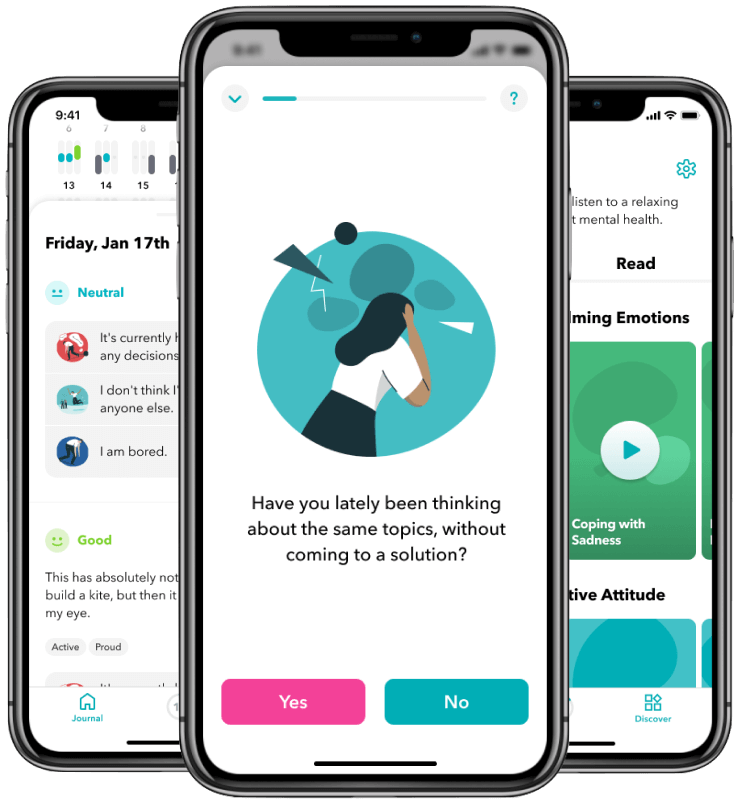
Screen shots from the Moodpath App depicting (from left to right) the mood journal, a sample question, and the insights screen. Sourced from https://mymoodpath.com/en/
2. Identify the context (environment, during what type of activity, time of day, etc.) for each interaction
I am usually at home, school, or in transit when I’m using the app – especially for the daily log, I try to do it whenever I have a free moment, but I rarely get to all three (morning, noon, night) in the same day. When I’m reading the insights I’m usually at home, because they tend to be sort of personal, and I like being able to feel safe and give it the energy it requires. Generally it’s an odd mix of environment and time of day because the way I interact with the app make me more inclined to use it at home where I can be assured of privacy and comfort, but the amount of times per day that I interact with it kind of necessitates out-of-the-house interactions.
3. Identify the types of feedback the user will need to get for each interaction (e.g. input received, task completed, button pushed, error made, levelling up, etc.)
There’s lots of opportunities for this app to make sound, but it doesn’t have any audible programming. You can set a reminder that pushes through a notification to answer questions three times per day, but it’s just a visual on your phone without any auditory elements. There’s also no sound for any of the actioned feedback, including in response to the daily questionnaires. Ideally, the points where sound could be integrated are as follows:
- notification reminder to answer questions
- opening the app
- completing daily questions
- insights available
- reading insights
4. Come up with a plan for the sounds you would design. As with branding, decide on a mood/tone using descriptive words, then parlay that into proposed sounds
Since the app is designed to be used for an intimate purpose (recording your general mental health standing), I think the sound needs to be subtle enough to not draw a ton of attention. From an ethical standpoint, any sounds the app makes shouldn’t add stress to the interaction in any way, either by being too loud or just generally annoying or overwhelming. However, I think if used appropriately sound could help motivate engagement and support users when they feel down, which is highly probable given that people who aren’t struggling with depression or mental health seem less likely to use this kind of app. It seems to me that sound and music could be integrated in a way the helps support the emotional resonance of the user interactions while remaining true to the personality and core vales of the app (“About Sound", Material Design).
Humanizing some of the interactions with sound so that it feels more like you’re talking to a person than an app would be a great place to start, but it could be difficult to ensure that these sounds all belong to the same cohesive choreography (“Sound choreography”, Material Design). I also think it would be hard to make skeuomorphic sounds since the actions they're tied to don’t necessarily have a real-world representation, which means that the sound will have to be abstract while still feeling somewhat grounded. The interactions I’ve identified for my sound design includes a mix of decorative sound for the reading of insights along with earcons to denote the actionable opportunities of answering questions, opening the app, and notifying the user when there’s feedback available. (“Applying Sounds to UI”, Material Design).
Though it’s not strictly advisable to use a ton of sound design when discretion is the priority (“Applying Sounds to UI”, Material Design) I think making the possibility of sound design available to people that want it could help support the underlying mission of the app to “guide you toward emotional well-being.” (Moodpath).
5. Create a "mood board" of sound files.
“About Sound.” Material Design, material.io/design/sound/about-sound.html.
“Applying Sounds to UI.” Material Design, material.io/design/sound/applying-sound-to-ui.html.
chaosportal. “Whistle 07.” WAV file, created 11 Dec. 2011. Retrieved from freesound.org/people/chaosportal/sounds/137106/.
counter-gamer. “Glass ding.” WAV file, created 8 Oct. 2017. Retrieved from freesound.org/people/Counter-gamer/sounds/404104/.
fractalstudios. “Coins Being Dropped-Assorted.” WAV file, created 19 Oct. 2016. Retrieved from freesound.org/people/FractalStudios/sounds/363090/.
Haykritch. “FX_Coins.wav” WAV file, created 6 Sept. 2017. Retrieved from freesound.org/people/Haykrich/sounds/401539/.
InspectorJ. “Bird Whistling, Single, Robin, A.wav” WAV file, created 27 Jan. 2018. Retrieved from freesound.org/people/InspectorJ/sounds/416529/.
jayfrosting. “Cheer 2.wav” WAV file, created 19 Jan. 2016. Retrieved from freesound.org/people/jayfrosting/sounds/333404/.
kvgarlic. “CreekandChickadee.wav” WAV file, created 14 Mar. 2012. Retrieved from freesound.org/people/kvgarlic/sounds/148909/.
“Moodpath App - Your Mental Health Companion.” Moodpath, mymoodpath.com/en/.
xtrgamr. “Bell ring.wav” WAV file, created 14 Dec. 2014. Retrieved from freesound.org/people/xtrgamr/sounds/257763/.
“Sound Attributes.” Material Design, material.io/design/sound/sound-attributes.html.
“Sound Choreography.” Material Design, material.io/design/sound/sound-choreography.html.
Timbre. “remix-3-of-of-adriann-s-harp-strum-freesound-149187.flac” FLAC file, created 20 July, 2017. Retrieved from freesound.org/people/Timbre/sounds/397937/.

Comments